‘No, I don’t write songs. My brain just doesn’t work like that. I’m a prose person.’
There was no doubt in my voice, because there was no doubt in my mind. The person who’d asked – my cousin Naomi, a musician – believed me. I believed me too.
I was a prose writer. My first collection had just come out as we were having this conversation. Since I’d given up directing and acting to finish my PhD in creative writing I’d been much, much happier in full charge of my fictional worlds.
Anyway, I ‘didn’t really’ sing. Except ‘just for fun’. So writing songs didn’t make any sense or having any baring on reality that I could see at all.
About three days after that conversation with Naomi I texted something along the lines of ‘Errr… I think I’ve written a song.’
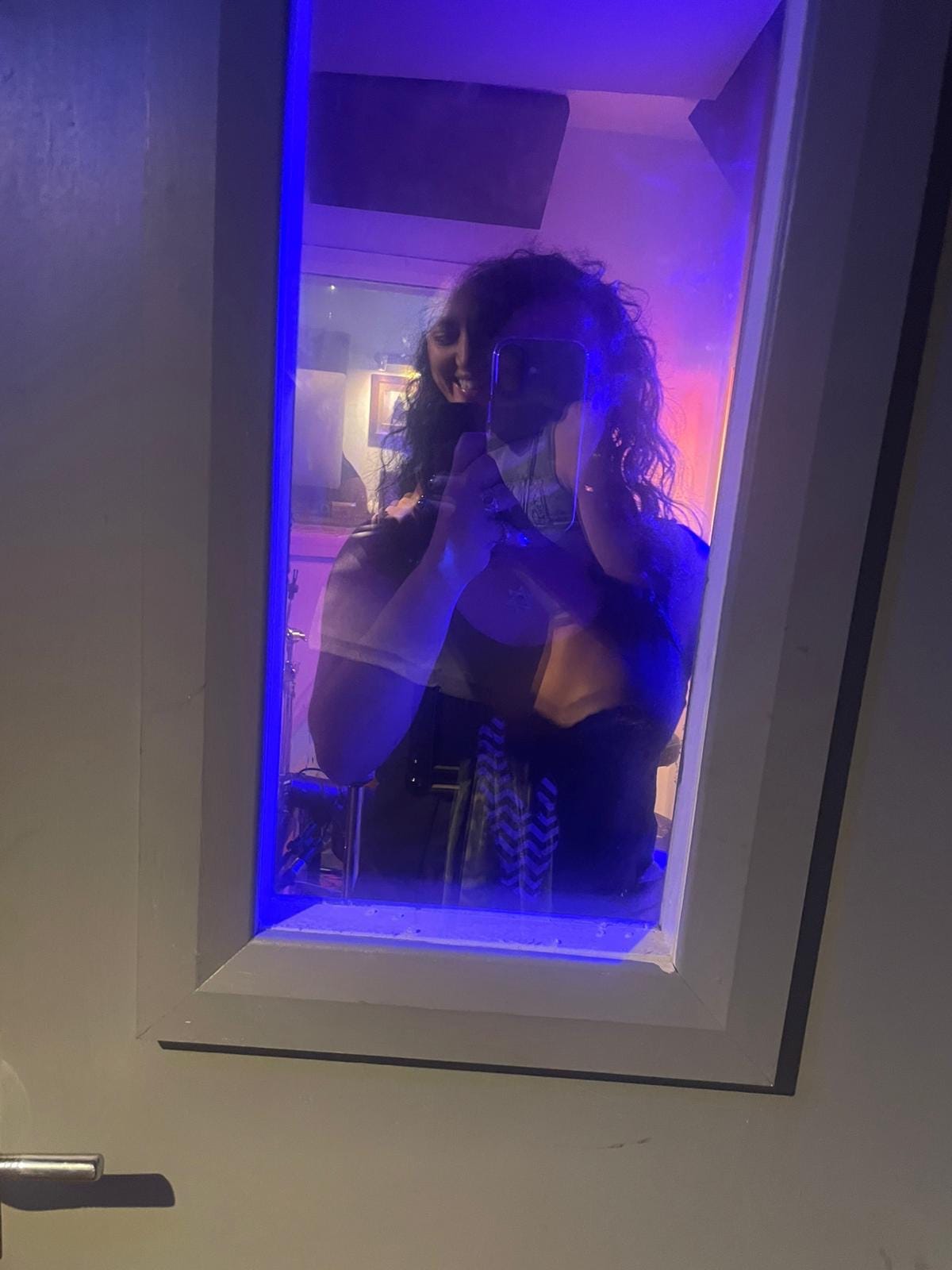
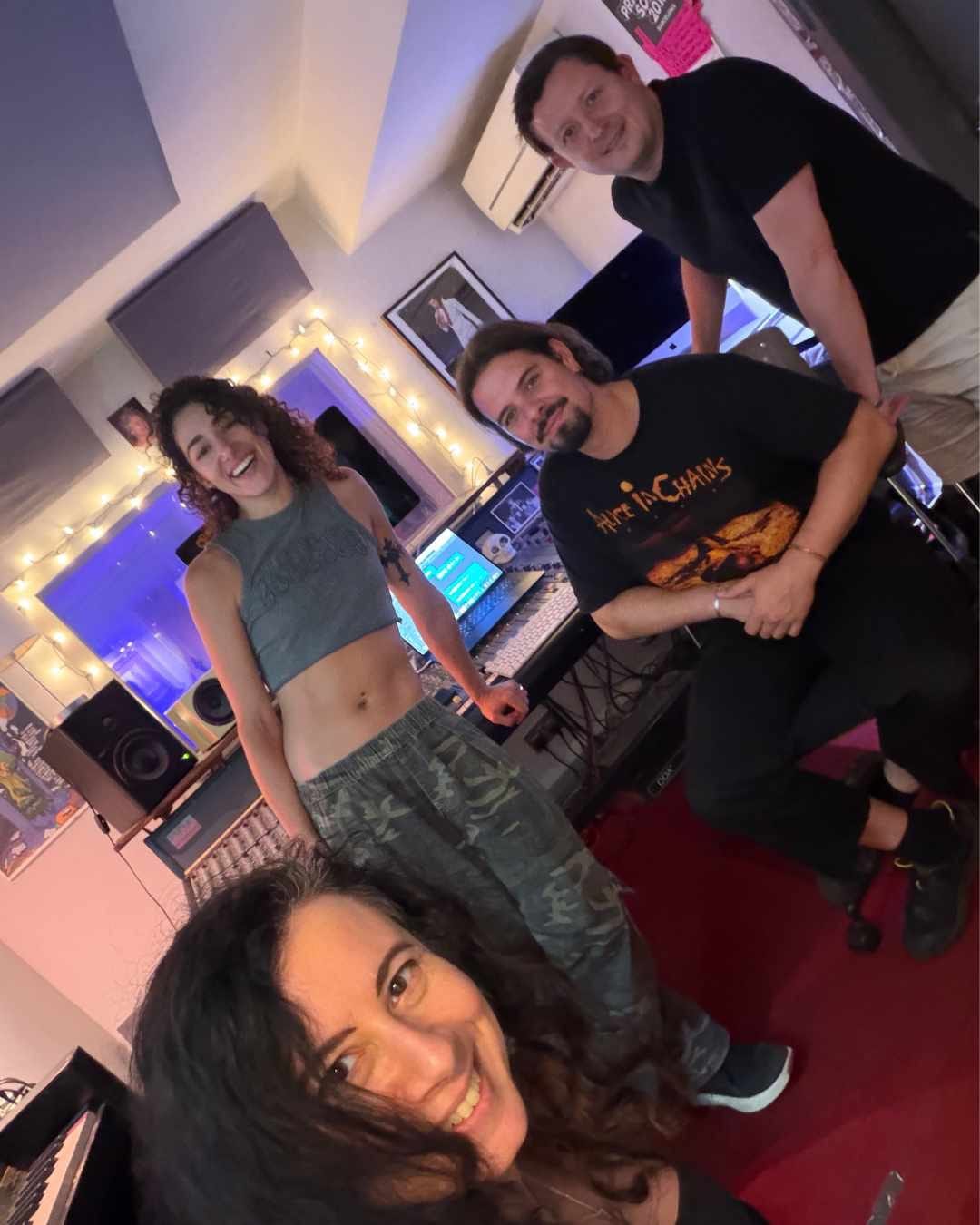
It was another four years until I had another conversation with a friend that became a conversation with another friend and then another conversation with Naomi that resulted in what happened this week: recording my first EP.
Certainty means something. But not necessarily anything to do with being right.
If I told you how many professional authors, journalists, editors don’t think they’re a proper writer, or don’t want to come and talk to me on The Writers’ Gym Podcast ‘yet’ because all the books, articles etc they’ve already created don’t count, only the one they struggling with now or haven’t written yet counts so they can’t possibly come on a podcast and talk to other writers… it would be a number large enough to make you wonder why I didn’t notice myself making the same mistake: choosing imposter syndrome over having a perfectly good time.
Collaborating with Naomi Banks
I still ‘don’t really’ sing or play an instrument. But I’m getting better at both. I’m a lot better at both than the one person it matters to be better than: previous me.
And I understand ‘really’ a musician and ‘not really’ a musician are neither a) binary or b) existent. Just like being ‘not really a writer’ is less a meaningful label and more a statement on self-esteem.
Once I spotted my limiting belief, I spotted my opportunity to have more fun.
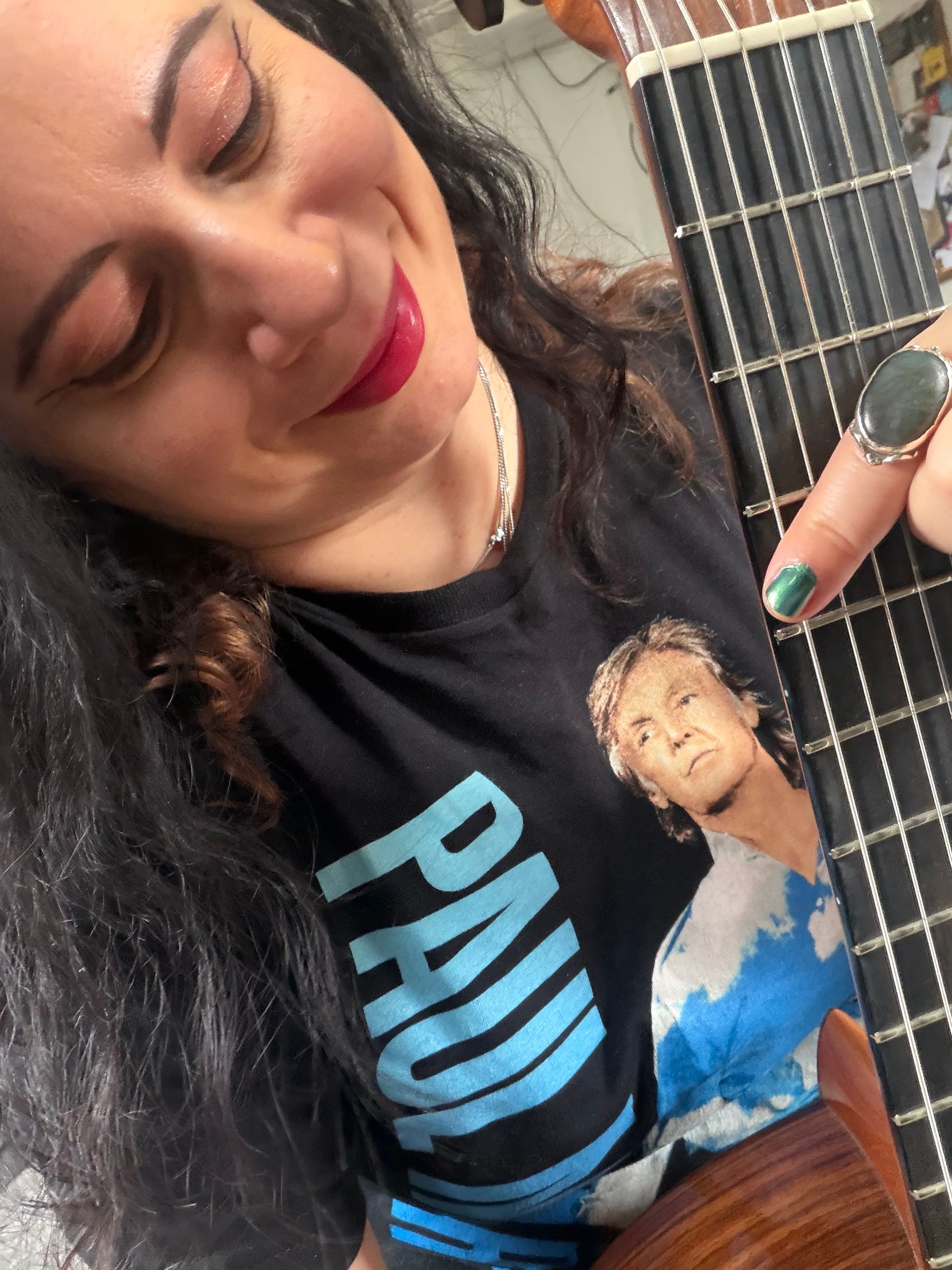
Five life lessons from falling in love with Paul McCartney
My first (and last and always) muse is eighty-four today.
I discovered Paul McCartney when I was ten and literally all of television seemed to be celebrating his fiftieth birthday. Watching A Hard Day’s Night and seeing the Beatles in their mop-top era for the first time, the only way I thought I could tell the difference was the way Paul held his guitar. I saw it during ‘And I Love Her’, and a part of me will forever be sitting an inch away from that tiny television.
Like me, Paul was left-handed. Also like me, he was vegetarian. And he was married to a Jewish American which, with my dual nationality, made it utterly clear to me all it would have taken was a time machine and I’d have been totally in there.
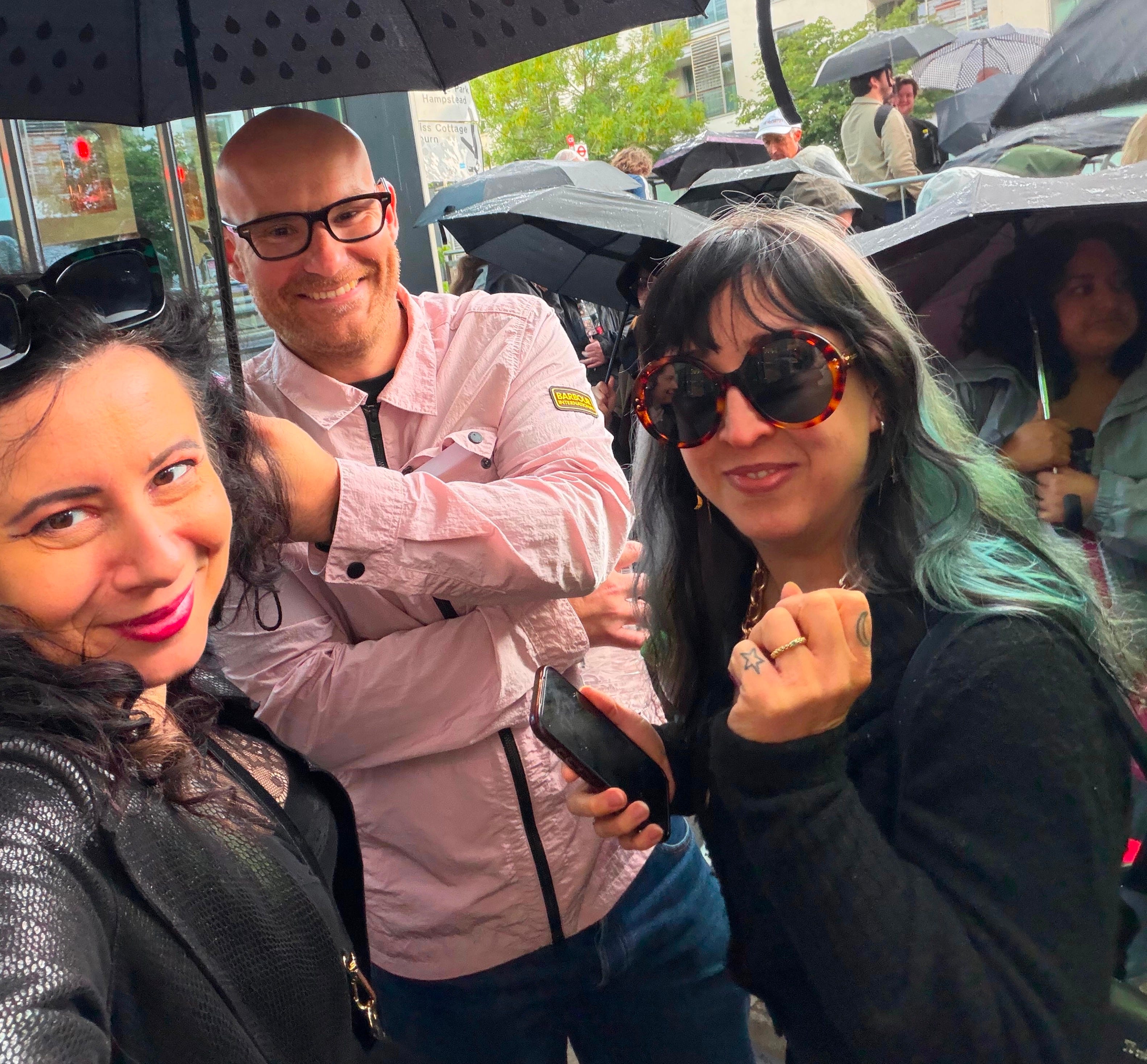
But the time machine was not to be, and the closest I’ve ever been to Paul was six rows from the front last Wednesday evening at the Roundhouse.
Twenty years beyond the age of his (or anyone’s) most famous song about aging, Paul mentioned yoga and vegetarianism and absolutely not knowing the secret. But what he showed rather than told us is what I think I’ve been learning from him all my life.
Paul’s talk with Rob Brydon focused on the new album, The Boys of Dungeon Lane: the person he was growing up in Liverpool and the memories that created the songs. But one of the non-album questions that will stick with me forever was his reaction to the ‘youthful’ question.
Twenty years beyond the age of his (or anyone’s) most famous song about aging, Paul mentioned yoga and vegetarianism and absolutely not really knowing what or if the secret might be.
But what he showed rather than told us is what I think I’ve been learning from him all my life.
Younger than I’ve ever been
I didn’t have half as good a time when I was what I now think of as ‘young’. My forties are a lot more fun than my twenties were; I am enjoying being who I am, the communities I’ve joined and created reflect my values and interests (of which joining the Paul queue four hours early with my Writers’ Gym Podcast producer at the Roundhouse, and making new friends together with other fans in the queue, is just one example). I am now old enough to quietly enjoy looking young rather than resent it, but I’m not sure looking young is the truth off it either. My dress sense, way of talking and moving and thinking, are all closer to who I am than they’ve ever been. I think that’s been the quiet goal: being interested, enjoying potential and discovery and new stories, songs and people. Discovering more about myself through collaborating with the people and possibilities around me. Which is exactly what I’ve always seen him doing.
Paul’s honest, surprised ‘I can’t believe it’ when reflecting on reaching this age and how it feels is familiar because it’s the reaction we see of anyone reaching any previously-perceived arrival point, and finding we’re still exactly who we were all along. Staying youthful, if it means anything at all, means staying present.
In my twenties I was in a hurry to grow up and be who I was ‘supposed’ to be. Now I know the value of curiosity, and seeing past my perception of the ‘shoulds’ to the ‘whats’ and ‘whys’ of who I am and what I’m here to do. Which means I’m very aware now that when (“please God”, as my grandfather used to irritate me by saying and I say regularly myself now) I reach eighty-four, I will know in a way I can’t possibly understand today how very young I was now.
Five of my favourite life lessons from Paul’s music:
You’re waiting for someone to perform with, but don’t you know that it’s just you… the movement you need is on your shoulder.’ (Hey Jude)
So often we think we need approval and understanding when what we’re actually looking for is permission. And the only person who can give it isn’t the one we’re outsourcing our free-will to; it’s the person in the mirror.
‘So lay down your umbrellas, strip off your plastic macs, you’ve never felt the rain my friend until you’ve felt it running down your back.’ (Mamunia, Band on the Run). We spend so much time trying to avoid feeling afraid, sad, out of control, but letting ourselves feel them means we don’t fear fear the way we did, and it brings us closer to each other and the world.
‘I can help you out, but I cannot help you in.’ (Little Lamb Dragonfly, Red Rose Speedway) One of the most important and least popular life lessons is the one about not confusing leading the horse to water with what happens when it arrives. We can’t help everyone, and accepting that allows us to truly help the ones we actually can, and/or who actually want the help.
‘Take these broken wings and learn to fly/ all your life, you were only waiting for this moment to arrive.’(Blackbird, The White Album) When things are bad it’s a sign it’s time to move on, yet we only see the crisis at the time and not the opportunity. When I look back, the great big and great good changes came on the other side of some kind of despair. It meant giving up something that wasn’t serving me anymore, if it ever had. And beyond fear is choice and realisation you were only waiting for this moment to be free.
I cannot choose between Live and Let Die and Let it Be. And maybe that’s the very point I took from him. Knowing the difference between what is in your axis of control and what is outside it; the difference between how much you care and what’s yours to control, and how to protect your peace and still take your own steps towards making your world the best version of itself.
InkCouragement: Creative Confidence with Dr Rachel Knightley is a reader-supported publication. To receive new posts and support my work, consider becoming a free or paid subscriber.
“So lay down your umbrellas / strip off your plastic Macs / you’ve never felt the rain my friend until you’ve felt it running down your back.” (Mamunia) For you, Paul, we did.
The easily-lost art of making time, and choosing thoughtful places, to be a good date for yourself.
I had a writing date with myself on Saturday morning.
A writing date is not an artist date. Not, at least, according to the famous artist date model: taking yourself somewhere to wander without responsibility or expectation. Those are important and wonderful too, but so are my writing dates. These aren’t about wandering without responsibility, though. On yesterday’s writing date, I had very important responsibilities:
Drink coffee (or heat-friendly alternative).
Work at my own speed (and no faster. Breaks to daydream and/or think around a problem are an important part of the job description).
Purple-edit my draft.
(Hand-edits have to be in purple. It’s part of the process, for some reason.)
Bad experiences and good intentions sometimes mean we step back from the fun of creating. We make the time we have about forcing ourselves into productivity, instead of dreaming our way in. Which, ironically, will usually turn out a lot less productive.
And which tends to mean other ‘shoulds’ creep in along the way. I shouldn’t feel like this. I should have done this by now. When X was my age they’d written Y books.
These ‘shoulds’ may not sound like the most seductive of calls, yet we’re so often taken in by them. We stop enjoying the moment in favour of punishing ourselves for the moment not belonging to a different version of who we’re supposed to be.
Which — like the story we’d otherwise be free to enjoy writing — we’ve entirely made up ourselves.
I transferred my notes to the Word doc in the afternoon, and put my reward-come-incentive of another in the diary. A second date, if you will.
Then, I stepped away from the computer. I spent time with my partner and friends, with more of my head and heart available than they would have been.
May we treat our souls at least as well as we treat our cars: with fuel for the journey, not as a ‘reward’ for getting through it.
Think on the Page…
Consider your last date with yourself. Answer from a place of curiosity, not judgment, and see what comes out when you do your thinking on the page instead of your head.
When was the last time I spent time with myself for the joy of it?
Where did I take myself, and what did we do together?
What do we love about it?
Where and when will next time be, and what will that look like?
Let’s see if we can sit down long enough to listen
I met my new dentist yesterday. He’s actually lovely. The ‘actually’ is completely unfair; there’s no reason he wouldn’t be lovely. Except for all the reasons in my head, most of which go back to primary school (where there weren’t even any dentists).
Disappointing the authority figures around me, and being humiliated as a result, looms large in my internal world. The ‘fact’ grown-ups somehow take against me and shame me – for not finding my exercise book in my tidy tray fast enough, not running fast enough around the block, not understanding the unwritten rules of social interaction or where the ball is going (usually at my face) – is not based on up-to-date information about me, or about the world. It’s about a 1980s primary school.
I am older now than any teacher is likely to have been in any of my primary school memories. My dentist does not see the child my brain thinks I become when I walk into his room (and, because he is a human being, potentially very likely doesn’t see himself as a ‘proper’ adult because nobody sees themselves as a proper adult; we all believe other people are proper adults and we are just pretending). He is an adult talking to another adult, with genuine interest in who I am and what I do. And because I have built my creative confidence muscles through regular use and can ‘what if’ my way beyond my fears, I can resist going into fear or victim mode and choose to show up instead as the person everyone in the world outside my head – everyone except me – knows I truly am.
Anyway, none of that is the point (Not anywhere outside my brain, anyway). The point is how little I could concentrate before going to the dentist.
I call that feeling beginner’s call, when I can feel in all of my body that beforeness. It reminds me of the feeling of time having stopped as stage management over the tannoy called me to my position for curtain-up. You can’t do anything in those moments of ‘before’. You can only wait, and focus on what’s about to happen.
Which is fine when it’s five minutes. The problem with anxiety, if it goes unchecked, is you can end up letting yourself live there. And (worse) thinking that’s helpful.
Luckily, my inner line-manager knows all about ‘beginner’s call’. They know the time before I do something new or challenging feels like this and they know something far more important I would otherwise forget: that it’s okay to feel this way. Therefore, the line-manager makes reminding myself this is something that happens, and needs time around it means taking that time is company policy.
When I came back from the dentist – who, as mentioned, was lovely – I did more of my work than I had in double the time before. There was no beginner’s call feeling. I could be in my own head and body. I could take my time. And when I take my time, instead of pushing myself to work at someone else’s speed, what I do is deeper, richer and better than if I’d forced it before.
Join me for Coffee & Creativity at Olympic Studios or the Century Club this month, or visit the Writers’ Gym for a Creative Cuppa online every week.
What’s perhaps saddest about these primary school memories is I was one of the luckier ones. I had a diagnosis. They knew I had learning difficulties (mainly dyspraxia, and mild dyslexia). But the message was always, fundamentally, disappointment. I was a nuisance. I was too slow. I shouldn’t find difficult the things I found difficult. Part of it was disguised as a compliment: they knew I was intelligent, but shy. I left primary and secondary school in a state of permanent hurry, which – ironically rather than coincidentally – reflects the posture problems around learning to walk by staggering forward instead of finding my own centre of gravity. This fear of being slow has become an ingrained habit of being early, and natural disorganisation and motor function issues means I relish in recognising what it’s helpful to delegate, and what it’s helpful to do myself taking as much time as I need. My inner line-manager reminds me to be proud of this. I’m not disappointed in who I am. I’m curious about what helps me be the best version of who I am.
I talk to my freelance-career-building clients about our line-manager relationships a lot. It’s often about noticing when our line-manager (us) is recognising our efforts or milking us for all the energy we have.
My back has been better since I noticed my tendency to really, really believe I ‘had’ to be at my desk. (Different had too, around working harder instead of better.)
The truth? The actual truth, not what it says about me but what it purely, simply is? That’s less complicated:
I write better when I move.
And by ‘move’ I don’t even mean standing up, sitting well, talking breaks to move my neck and back or walk around. I mean move from the desk to the sofa.
Longhand, or laptop doing what it’s named for and being on my lap, more happens when I move around.
Because that’s an important part of writing ourselves a truer story than we might have been telling ourselves. Building a healthy professional and personal life often needs to look less like hurry and a lot more like this:
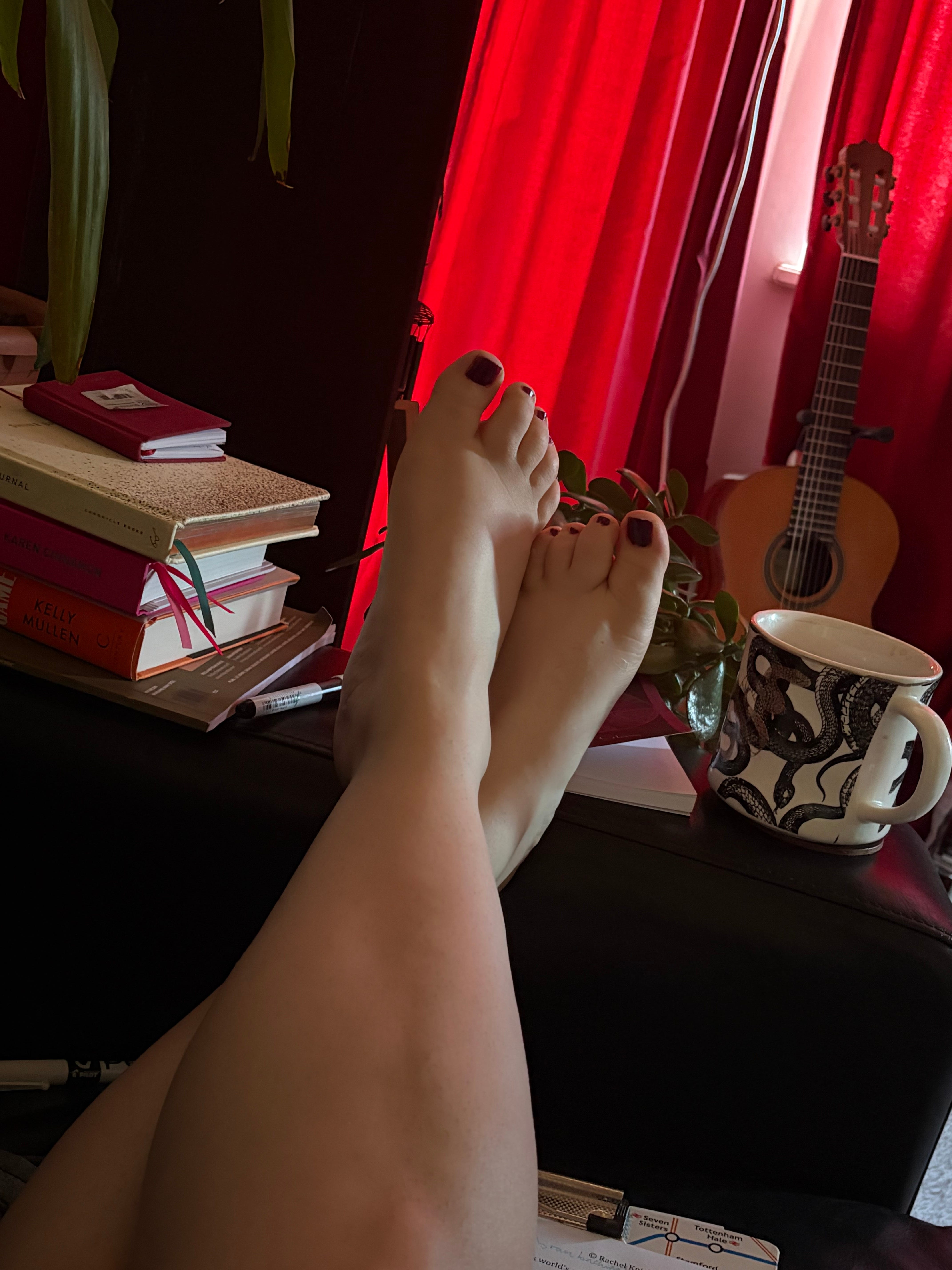
Desk of the day: my sofa, various works-in-progress and enormous coffee mug.
Think on the Page:
How might your inner line-manager support you this week?
Remember these questions work best if you let them take you by surprise. Start writing before you know exactly what’s on its way. You’re welcome to share in comments, but these aren’t for me or for anyone else – they’re for you.
If your line-manager gave you one piece of advice about how you talk to yourself in your head, what might they say?
When does your line-manager need to step it and ask you to recognise your efforts before leaping straight to the next thing on the list?
If they gave you one suggestion for your work or life, what would it be?
A book birthday, a heat wave boundary and an ode to Sir Michael Palin
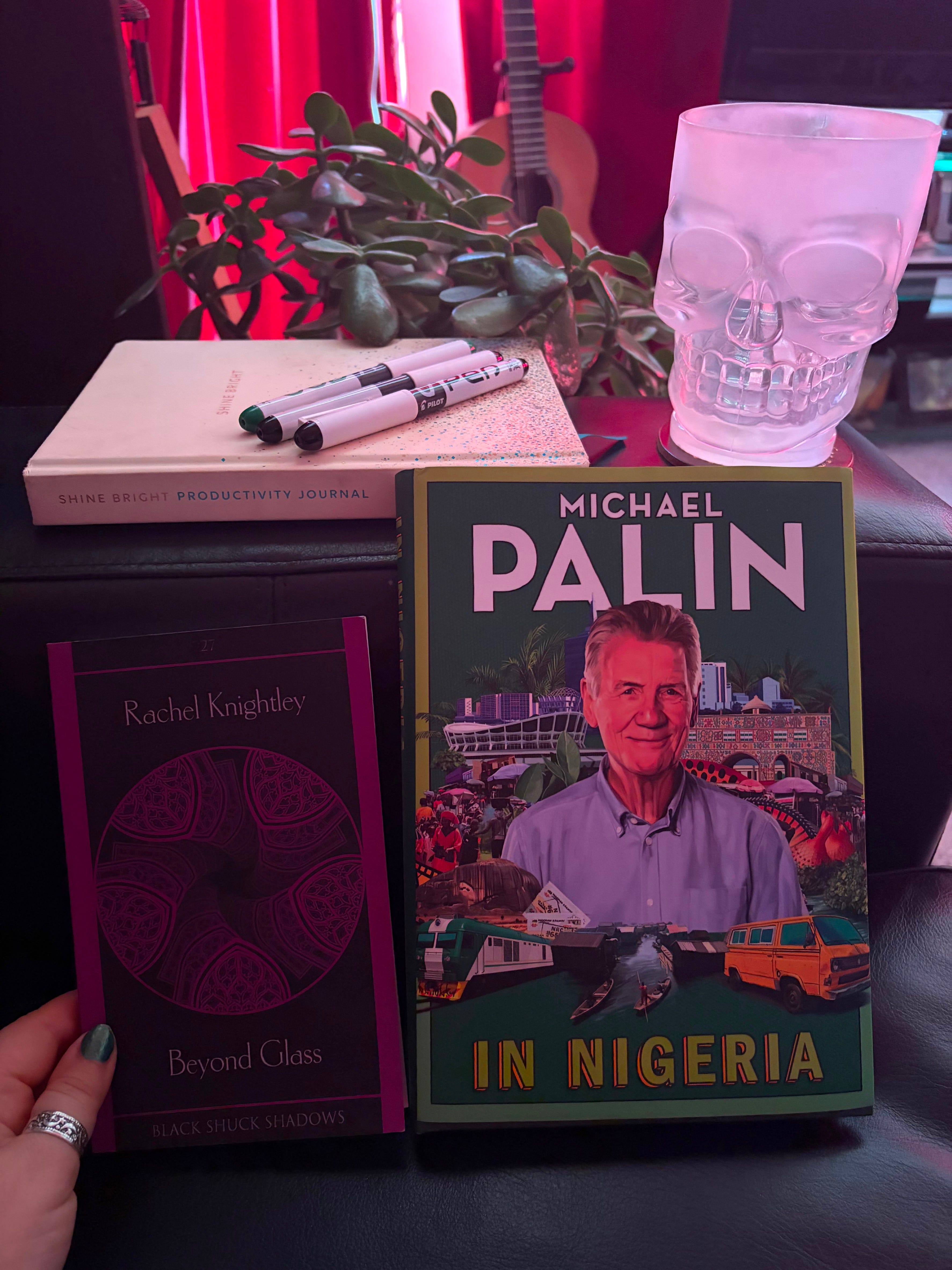
Here’s Beyond Glass (five years old the Wednesday: join the birthday week giveaway on Instagram) next to Michael Palin in Nigeria. Here also is my sofa writing burrow with closed curtains because I can’t deal with heat. Each to our own…
Feel free to suggest alternatives, but if I had to show the aliens the best of humanity I think I’d start by exhibiting Michael Palin.
You would say that, you might say. You’re a creative confidence coach. You work with jigsaw careers. You help people develop professional and personal happiness through unearthing all the interests currently on their page/in their world, and those yet to be part of the picture. Michael Palin (you might say) personifies the value of a jigsaw career. Acting, writing, presenting and traveling the world (with a predilection for its most difficult bits) aren’t obvious links for every person who does any one of those things, any more than having clients who range in age from six to eighty is normal for every coach. It’s about knowing who you are and not thinking you have to choose between the aspects of your identity, but celebrating the entirety.
Well, yes.
But, more importantly, no.
It’s the ‘nice’ thing.
Or, rather, it’s the misunderstandings about niceness and what niceness (when there’s clarity beneath it) allows him to create.
In case you don’t know (though you almost inevitably do), the first thing people say about Michael Palin isn’t the BAFTA or the knighthood; it isn’t even Monty Python’s Flying Circus or Around the World in Eighty Days. It’s how nice he is.
But here’s the thing about ‘nice’. There’s what it is – and then there’s what it really is.
Why I would make Michael Palin ambassador for my species is I believe his niceness is the antithesis of the ‘I don’t mind, it doesn’t matter’ pseudo-niceness, the one that leaves us waiting politely for the world to guess what we need and want. The one that leaves us living in the gap between who we are inside and who we want to be in the world.
As I think about Michael Palin and the life lesson he’s been to me, I’m reminded of what was told to me as an anecdote but lives in me as a cautionary tale. A former teacher who was a massive role model to me had a number of catchphrases she’d inherited from her own adults, one of which was ‘I want don’t get’. Years after I’d left school and was studying for my PhD, she shared with me that when her father found out she would have liked to do more further study herself, he asked why she hadn’t said anything. Her answer – which she even didn’t say aloud to him then – was because that phrase was his phrase and she’d believed it.
Gratitude is not the opposite of vision. It’s not the opposite of ambition. For ourselves, or for the change we can make in our world. But our minds can make assumptions that keep us small; keep us waiting for something that doesn’t know we’re there. Or, that doesn’t exist until we initiate it and make it exist.
Putting together a jigsaw career doesn’t come from the kind the pseudo-nice of waiting to be summoned, or doing what we’ve internalised we ‘should’ do and not looking at the distant, still-vague horizons of our possibilities. Michael Palin’s niceness is not that of waiting politely on life’s corner but of moving through its water. His awareness of what’s around him, his appreciation of people, places, art and life is not instead of being the engine, seeing what you want to create and putting your strength behind creating it, but because of it.
Last Monday evening I saw Palin speak at a private venue in London. One of the things he talked about was the greatly-beloved Knights who say Ni scene from Monty Python and the Holy Grail: how physically uncomfortable filming was; how convinced he was – as his woolly armour stuck to him in the unpleasant weather and got heavier with every take – that it wouldn’t be worth it. It wouldn’t be funny.
Even as he spoke of it he instinctively did the voice of ‘Ni’, and while no one in the audience joined in you could feel us all doing so in our heads. There is so much love for that scene and concept. But the point in telling the story was he really thought it wasn’t going to be funny. Not worth the discomfort. He was laughing at himself when he told the story, but it brought up a question for me which I asked at the end. He’d pushed back on the Knights Who Say Ni because of personal discomfort first and thinking it wasn’t funny second. And he’d been wrong. But what about when he’d been right? What happens in writing partnerships when you see something really is going the wrong way? Where’s the line between peace and politeness on one side, and the right thing for the work on the other?
As I expected, he didn’t really answer directly – although he was (unsurprisingly) lovely in talking about it. I don’t think this was conscious avoidance; I think this is one we genuinely don’t know until we’re in the moment. Because even when you have been nice for a living, including through the most difficult bits of the world, it doesn’t mean you’re a pushover. ‘I don’t mind’ doesn’t create art, or life. Having a sense of what we want to create does. Being nice is how to work with and appreciate people as we consistently do the work of creating the art, work and life we want. That’s the real power of nice.
Another thing Palin mentioned on Monday that is great jigsaw-career advice: he was the fifth person to be asked to do Around The World in Eighty Days. Even now as second in the queue behind Attenborough as national treasure of travel, it’s important to remember that (also like Attenborough) there was no God-given decree. Just as Attenborough only ended up in front of the Zoo Quest camera when someone was ill, we do not know what our current circumstances could be Chapter One of, but creative confidence means asking ourselves how, not if, we take those circumstances forward.
My first short story collection, Beyond Glass, will be five years old this Wednesday 27 May. I’m running a daily Instagram giveaway in the UK with online options if you’re outside the UK. Join in here.
Kindness has often been described as niceness with boundaries, and niceness as kindness without boundaries. Being kind to the work we’re creating means setting those boundaries, knowing our values and our direction of travel. It means creating a map of a land that isn’t only uncharted but doesn’t even exist yet, and won’t until we commit to creating it.
Boundaries around our time (for being not at work in some of our cases; for showing up for our writing in others) actually gets better results for our friends and family, clients and colleagues not to mention ourselves, than having no boundaries at all – which leaves us unfulfilled, tired and permanently in the waiting room for work to call us in. The things Palin has said no to as much as the things he’s said yes to are how he gets to do what’s most important to be done.
That’s what I want the aliens to know. What we do is important. But how we do it, and how wholeheartedly we choose what we do and (see photo of me in the heatwave) don’tdo, can be more important still.
Think on the Page…
If there’s a phrase you’ve inherited, what is it? Whose voice do you hear it in?
In what ways do you agree, and disagree, with that phrase now?
How do your circumstances or values differ from the person who said it?
If that phrase weren’t true anymore, what words could be true instead?